



On the relationship between audio and image in the live music experience of July 17th 2010: the concert coincides with the screening of the film La chute de la Maison Usher (Jean Epstein, France, 1928).
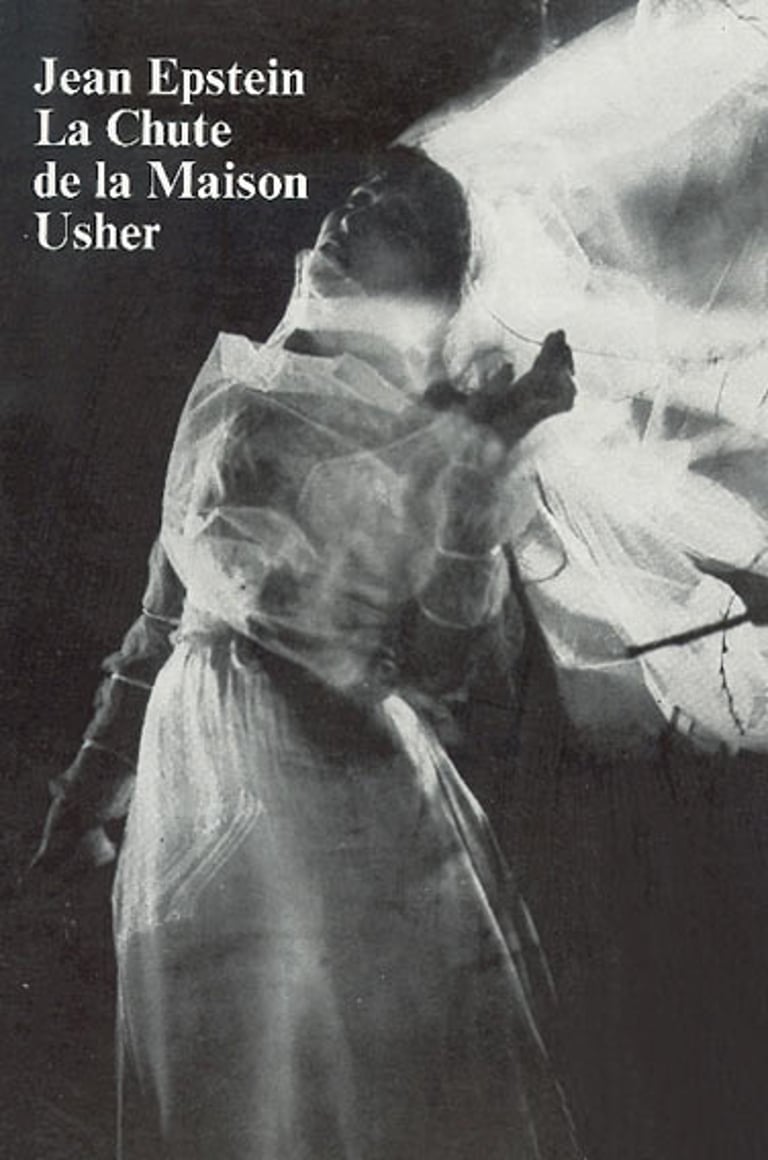
As part of the event Suono-Immagine produced by the Conservatory of Milan in collaboration with Anteo Spazio Cinema, on Saturday the 17th of July 2010 at 10 pm (Conservatorio di Milano G. Verdi), La chute de la
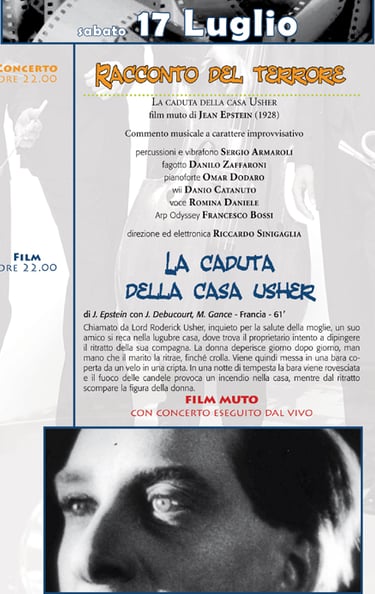
Maison Usher (Jean Epstein, France, 1928) has be screened with live improvisations by Riccardo Sinigaglia ensemble with the participation of Romina Daniele.
The Echoes of Usher – 2026 Official Label Edition. New Master, critical apparatus, and official previews currently in progress. Stay tuned for details regarding the release and physical media distribution.
The Echoes of Usher is part of RDM Records' 2026 Official Label Edition production cycle: a research and curatorial project focused on electroacoustic sound textures, signal restoration, and high-fidelity remastering.
Original performance flyer (July 17, 2010).
The Essay
Editorial Note (2026 Edition): > Originally written in 2010 on the occasion of the performance at the Milan Conservatory, this essay is presented here in its revised and definitive version, aligned with the archival release «The Echoes of Usher» (2026 Series, RDM Records). Footnote numbering has been adapted for standalone web reading (for the complete monographic commentary and global apparatus, see «ElectroAcoustics Magazine», 2026).
Introduzione
Within the framework of the «Suono-Immagine» festival, organized by the Milan Conservatory in collaboration with Anteo Spazio Cinema, a live improvisation concert took place in coincidence with the screening of the silent film La chute de la Maison Usher (by Jean Epstein, France, 1928). The expressions «live concert» and «in coincidence» are employed here to designate the distinctiveness of the experience under inquiry, and thus its distance from the more common concept of «musical commentary». The latter has given rise, throughout the history of the relationships between music and cinema and between sound and image [1], to no few misunderstandings as well as to fruitful debates. Coincidence, which is to say interaction and a dialectical relationship between two media — the music improvised live by the ensemble, and the silent film being screened — rather than commentary, insofar as the latter is by definition «an interpretation, an evaluation, a judgment», coming to identify across art history and criticism — and consequently within a specific history of music or «film music» — «that which places itself in the background relative to the true work of art». The discourse of cinema as a work of art, along with the very «concept of modernity», cuts across historical periods in relation to the thought and philosophy of its authors. Consequently, a text (specifically cinematographic) constitutes an act; that is, it measures itself through what is perceptible of its author’s work via more or less explicit enunciative marks [2].
Given that the film on the one hand, and the concert on the other, represent two distinct languages, each endowed with its own structures and properties yet powerfully interacting, it becomes clear how the experience under inquiry generated a unique and unrepeatable level of existence for the work of art. This level of existence, which is termed audio-visual, took place starting from the interaction/coincidence between the silent film screened — image — and the live concert improvised — sound.
Sound, Music, and Silent Cinema
As we have previously clarified [3],in order to speak of sound in cinema, it is necessary to distinguish the sound dimension—which constitutes a network of aesthetic, technical, and linguistic relationships—from the music of a film, which intervenes upon the meaning of the filmic reality by virtue of its formal qualities and its modes of realization-production.
Our experience of improvisation in relation to Epstein’s silent film operates within the realm of its sound dimension rather than that of film music proper. This is due to the absence of both the conditions for a fully structured intervention upon the narrative—which would only be possible by excluding improvisation—and the relationship with the modes of realization-production, which would have been possible had we collaborated with Epstein back in 1928. However, if we consider the intervention upon the meaning of filmic reality via direct sound capture (in presa diretta)—the core condition of our experience—and by virtue of its formal qualities, we realize that the aforementioned sound dimension in cinema, as a network of aesthetic, technical, and linguistic relationships, can either include or exclude the music of a film, but not vice versa. In other words: music can operate within the sound dimension in cinema independently of the film's realization-production. And this is precisely our case.
This was not always the case in silent cinema, whose history is rich in live musical accompaniments—practices that, moreover, have very often represented an encumbering aesthetic legacy in sound cinema from its earliest days up to the present. Indeed, then as now, there remains the open problem of «a use of sound in a complementary and dialectical function relative to the image and editing, rather than a purely integrative or pleonastic one» [4].
Such commercial exploitation or pleonastic usage thus also constitutes the underlying reason for the rejection that many cinematic authors manifested toward sound at the moment of its historical appearance—which, it should be recalled, occurred in 1927, a mere year prior to Epstein's film under inquiry.
In light of these considerations, La chute de la Maison Usher stands as an emblematic example of this debate, being a silent film released precisely at a time when technical means would have already permitted sonorization (sonorizzazione) [5] Within its strongly enunciated visual charge—frequently defined as an emblematic fusion of Impressionism, Expressionism, and Symbolism—everything in the film tends toward sound, toward what we identify as the sound dimension of the representation. This is achieved through well-marked references to natural noises, otherwise known as environmental sounds, as well as to disparate musics.
The sound dimension of this film, despite the absence of actual recorded sound, is particularly rich and enabled us to intervene at the level of «added value» (suono aggiunto) [6] in diverse ways, both in modes and in gestures: at times literally sonorizing (sonorizzando), as in the emblematic case of the opening (and closing) titles and the incipit; at other times dramatizing, as in the emblematic sequence of the closing of Lady Usher's coffin [7].
Jean Epstein’s Innovations
Epstein’s 1928 film, beyond genre definitions that are ultimately of little consequence [8], stands among the most successful expressions—in silent cinema on the threshold of sound—for the affirmation of cinema as a medium in its own right, which is to say cinema as art. From the early 1920s, Jean Epstein embodied the prototype of what thirty years later, particularly with the French Nouvelle Vague [9] —and more broadly with the international nouvelles vagues—would be defined as the «auteur»: the filmmaker who is also a theorist, writing and producing his work while infusing it with his thought and personal worldview. This represents a mental disposition and an operational condition that indeed, in relation to personal and national styles, characterizes the so-called historical avant-gardes of 1920s cinema—namely the French Impressionist movement, German Expressionism (principally represented by directors Robert Wiene, Fritz Lang, Friedrich Wilhelm Murnau, and Georg Wilhelm Pabst), and the Soviet School (principally represented by directors Sergei M. Eisenstein, Lev Kuleshov, and Vsevolod Pudovkin).
Prior to the establishment of a standardized cinematic language, historically termed the «classic Hollywood model»—though it would be better termed the «classic model», insofar as it was constructed over the course of a history that was not merely American, and to which the highest-level experiences contributed, including the one under consideration here [10] —as well as following its breakdown, which unquestionably occurred from the very dawn of modern cinema, the «need for self-reference inherent to modern culture itself» unfolds «from within the language» [11].In this sense, a certain silent cinema of great stylistic weight, such as that of Jean Epstein, would undoubtedly influence all subsequent filmmaking—beginning in that very same year, 1928, with Luis Buñuel’s Un chien andalou [12] —as well as auteur cinema of all eras.
The pillar around which everything revolves is subjectivity: of vision, of the author, of the medium asserting itself, of the characters, of the set design, and of the audience that interprets. Jean Epstein’s film is unquestionably emblematic of the attention devoted to such subjectivity, the rendering of which is entrusted to the most disparate technical apparatuses, from optical effects that alter the vision of the image to the so-called «rapid rhythm» of montage [13], a «discontinuous» montage whose concept comes remarkably close to what we define as «audible montage» [14], referencing both cinema and electronic music. An emblem of such montage presents itself in the sequence of the closing of Lady Usher’s coffin.
Apparatuses Compared: Silent Cinema and Electronic Music
Jean Epstein is the one who particularly insisted, in his writings, «on these subjective and dreamlike states that characterize, in his view, European cinema and, in particular, French cinema» [15].
Just as cinema fixes reality, showing us aspects of it that cannot be perceived within its flow or from within, so too sound recording allows us to work with sounds and unveil otherwise unknown facets of them through direct work inside and upon the material itself. In this sense, the spectator (or audio-spectator) and the listener engage with a work in the active manner demanded by a certain cinema—conventionally defined as «auteur» cinema—and by the composer of electronic music: adopting the state of attentiveness required by the relationship and confrontation with differently processed material.
Cinematic devices such as slow-motion movement or, conversely, the close-up, as well as compositional devices that vary in diverse ways the time of recorded sound (be it natural, urban, or human), similarly reveal «completely new structural formations of matter» that are nevertheless absolutely real, being constitutive of that filmed real movement or that reproduced sonic consistency originally captured from reality.
In light of these assertions, and considering that I have already had occasion to address the relationship between cinema and electroacoustic music regarding composition and montage [16], I outline the key points of the discourse as follows: the multimedia language common to both cinema and electronic music consists fundamentally and technically, on the one hand, in the recording/capture «that fixes» [55] reality onto a medium; on the other hand, in montage understood as an «active instance of organizing discourse»—that is, the instance that asserts, in a single gesture, «both the materiality of the fixing medium and the presence of an organizing will external to the sound» represented by the author, thereby enabling «the sound scene» [56]. Ultimately, in the words of Delalande, «electroacoustic music situates itself between “music”, an art defined by its past, and “technological arts”, whose boiling crucible is the audio-visual world» [19].
Musical Disposition Towards the Film
Let us speak of sound, with the meanings the term assumes when considering the expressions «sound matter» and «sound object». The first term—encompassing the idea of «constructing timbre» and «designating that very thing from which the composer works—appeared in Western music at the exact moment it was no longer satisfied with classical elements: notes, themes, lines, arpeggios, chords» [20]. The second concept is owed to the engineer, musician, and radio operator Pierre Schaeffer, exponent of «concrete music», who used it to designate sound units perceived in their own matter, structure, quality, and perceptual dimensions, detaching them from their initial, real, or imaginary cause. In particular, the «sound object» is «a new object, existing in every respect», something distinct from a simple recording, «from the simple trace of a past event» [21].
In light of what Chion defines as the «audiovisual contract» [22], we have literally given rise to an unmediated «audiovisual dialectic» which, far from involving total fusion, presupposes the disparity of its terms, existing «separately at the same time, each on its own side» [23]: a relationship between the «images, the sonic and the visual», «without subordination or commensurability» [24]. Furthermore, the expression employed here for the first time—«sonic image»—is strictly tied to this «audiovisual dialectic» as well as to the aforementioned metaphor of «counterpoint» [25].
Jean Epstein did not fail to concern himself with the so-called «visual rhythm», in which, indeed, all Impressionists identified «the main matrix of film», confirming their focus «on emotions rather than stories»; an «insistence on the rhythmic element» that, as the authors themselves emphasized, «placed Impressionist film closer to music than to any other art form» [26],
This aspect brings Impressionist film particularly close to Soviet experiments, and specifically to the ideas of Ejzenštejn, who likewise defines rhythm as a «generalized integral representation of the process», arising through «the alternation of contradictory moments internal to its unity» [27]. Jean Epstein’s montage undermines both the «realistic and momentary» character of the image and the «linear and chronological notion of time» in action.
In consideration of this type of montage, our music cannot relate to the visual in a «normalizing» or «stabilizing» manner; being improvised, it depends on the conditions determined by the improvisational practice in that hic et nunc. By virtue of our music, the film as a «reproducible work of art» has gained that element of primordial authenticity, its aura: «the hic et nunc of the work of art—its unique and irreplaceable existence in the place where it happens to be» [28].
The spectator can clearly feel how the music «saturates» and «short-circuits» the image [29]; that is, how it charges the image with itself as an external element that becomes internal in a dramaturgetical manner, but above all becomes the bearer of a meaning beyond the filmic one. Furthermore, it continuously manifests the full power of its activity as an autonomous language with strong marks of enunciation, mostly displaying sparse «points of synchronization» or «false/avoided points of synchronization» [30].
On these latter points and their definition, I dedicated myself in the aforementioned study on audiovision, in which I outlined an audiovisual analysis of Louis Malle's debut film, Ascenseur pour l'échafaud (Elevator to the Gallows, France, 1958), in which Miles Davis's soundtrack music was recorded while being improvised based on concise notes taken by the composer on the one hand, and concise directions provided by the director on the other.
In fact, in both cases, the musicians, through improvisation, execute «"naturally" delays and anticipations, precisely as a function of the discontinuity of the image montage» [31].
To these technical considerations regarding language, dramaturgetical ones are added concerning the representation of the scene—both visual and sonic—which we have sought to adhere to in its aesthetic rendering. We refer in particular to the so-called «dreamlike dimension» of cinematic representation.
The filmic image is a «pure optical image»—that is, not indicative of an objective reality in the sense that «the House of Usher is the House of Usher»—but rather denotative of an abstract world in which «the House of Usher is what can be seen in details, movements, fluctuations» [32], It is a sober and rare image that always refers to a character, «so as to show us pure descriptions that erase themselves in the very moment they are traced» and that «bring the object each time to an essential singularity and describe the inexhaustible, because they refer endlessly to other descriptions» [33].
What derives from this, on the spectator's level, is an extreme form of indiscernibility between real and imaginary, physical and mental, objective and subjective. This mechanism culminates in the opposite pole of the scission between dreamlike experience and narrative reality, as emerges from the comparison between the film's two emblematic sequences:
The protagonist's death and the closing of her coffin (from the completion of the painting to the shutting of the lid, roughly between minutes 25 and 36), which bears the hallmarks of a dream despite being a real part of the narrative;
The woman's resurrection and the collapse of the house (from the man's dash upon hearing his wife awaken up to the final collapse, roughly between minutes 54 and 61), which possesses the traits of narrative reality, yet strikes the spectator as a decidedly fantastical finale.
In particular, only the final collapse of the house will characterize the resurrection as a real event within the filmic fiction; thus, the spectator recognizes the dream as typical of the dreamer (the protagonist) and attributes to themselves the consciousness of the dream (that is, the dimension of the real).
The spectator's recognition of the preceding events as a «dream» occurs with the manifestation of the final implied dream. The first moment consists of the protagonist's delusions and agony during the obsessive painting of his wife's portrait, as she falls ill at an inversely proportional rate: a mysterious and improbable event, yet narratively plausible (the explicit dream). The second moment resides in the tangible final collapse of the house, occurring simultaneously with the resurrection: a decidedly fantastical and implausible event, whose nature as an implied dream is declared by the film itself through the calamity of the collapse.
Improvisation and the Relationship with Filmic Language
In general, a certain «audiovisual consistency» is always quite explicit—an expression that denotes «the way in which different sound elements—voice, music, noises—are more or less integrated into the same global paste, a texture, or, on the contrary, deployed each separately in an extremely legible manner» [34]. Considering our ensemble, these three elements were, as if naturally, entrusted to certain instruments rather than others.
In particular, the attacks and air emissions form a single whole with the sound of the bassoon from which they originate; meanwhile, the VST instruments utilized by Maestro Sinigaglia are articulated predominantly in a noise-oriented key and are clearly audible in relation to the opening scene of the film, in which a man treads upon a rough path strewn with small hills and broken branches. The Arp Odyssey played by Francesco Bossi also produces, when required, the sound of the wind.
The instruments functioned in both a commentary and a descriptive manner. The voice, moreover, sometimes joins the visual data, further reinforcing it, and at other times constitutes its own autonomous layer in relation to the music.
In the case of the first sequence, strange whispers and sighs in a «non-language language» characterize the visual field in the soundscape until the exit from the inn. These vocal components, on the one hand, draw inspiration from the objective situation of a group of people in a dim, heavily chiaroscuro-lit setting, who seem to whisper amid feelings of fear, dread, uncertainty, surprise, and panic (the patrons are indeed terrified from the moment the stranger pronounces the name of the dark and mysterious Ushers); on the other hand, they in no way respect the lip movement of the characters, nor their placement in the foreground or background.
The vocal components «interlocute» within the film, and this immediately appears unusual. The condition of indeterminacy of the visual scene, at the narrative level, is likewise reflected in the sound scene; at the same time, however, the latter develops along an independent plane and «adds» to the visual data its own aesthetic disarticulation, bound to the difficult placement of the sounds themselves: unlike the other instruments that create «ambience», they prove estranging because they stand out to the ear both due to their resemblance to the visual events and their divergence from them. It is as if they position themselves halfway between the diegetic and extradiegetica dimensions.
This singularity derives entirely from the very experience of scoring a silent film and is made possible precisely by this nature: the audio-spectator does not expect sonic interventions that relate directly to the diegesis or interlocute with the events of the film. Even less do they expect such a singular interlocution by means of avoided synchrony—that is, one capable of provoking enunciative discrepancies.
In this passage, as in the other emblematic sequences, what charges the images with meaning—beyond their literal sense—is the voice as such: the human voice, the human sound par excellence, that sound which cannot be associated with anything other than a body that emits it: «it is directed outward by the (objective) absence of any interlocution in the film; it gives the impression of addressing the spectator, and therefore of originating from the enunciative origin» [35]. This estranging condition thus configurations itself as a sort of decentralized «voice-subject», vigilant in avoiding synchrony along the terms already delineated.
If it is true that at the moment of improvisation—understood as the live «sounding and musicalization» of the film—we as musicians literally participated in the experience of the film, the following reflection is equally valid for my operation: «The enunciation that makes itself seen is like the author writing in the first person: on the one hand it exposes the "filmic deception", on the other it forms part of it» [36].
In the resurrection sequence as well, the vocal intervention is lyrical, yet more deliberate and marked by an intense tremolo from the moment the woman reappears onward. In the immediately preceding shots, the voice intervenes with brief, distant long tones and semi-whispers, effectively giving body to what Roderick Usher hears. This constitutes the only entirely linear instance of a relationship between voice and image in which the interlocution within the film is strong: the voice embodies precisely the external, distant, non-real voice—otherwise merely imagined—to which the characters refer as if referring to a ghost (and indeed, they refer to the ghost of Madeline Usher). This direct reference to a presence external to the tangible objects of the diegesis, to a ‘non-real’ or presumed presence within the film, renders my vocal intervention perfectly linear, in that my voice participating in the sounding of the film is decidedly external to the film itself: nothing could be more pertinent.
In the sequence of the closing of the coffin, the estranging condition is instead even greater than in those described previously, as the minimal terms of the voice's interlocution within the film are reduced almost to zero. In the dramatic sequence of the death, there is no longer any female figure—neither real nor presumed—but rather a coffin and Mr. Usher's despair before it. The music asserts itself as a true soundtrack score, assuming the more or less decisive tones of a funeral march, and operates in this way as both «reflection» and «commentary» [37], producing both effects of unpredictability—as we have seen—and of maintenance.
In this singular manner, the music positions itself both outside and inside the frame: it is simultaneously «in the pit» and «on the screen» [38], as is rarely possible within a strictly filmic domain.
The rendering of the scene proves, in the end, so exemplary as to appear calculated; we well know, however, that this was not the case, by virtue of the improvisation that formed the foundation of everything. Hence the extraordinary nature of the experience and the raison d'être of these pages.
Footnotes
[1] The use of «image» in the singular refers to the concept of the «singularity of the cinematic image», upon which we will dwell later, both in relation to the «singularity of sound» and to fundamental aspects of the sound-image relationship—in particular within the section Apparatuses Compared: Silent Cinema, Electronic Music.
[2]The use of «image» in the singular refers to the concept of the «singularity of the cinematic image», upon which we will dwell later, both in relation to the «singularity of sound» and to fundamental aspects of the sound-image relationship—in particular within the section Apparatuses Compared: Silent Cinema, Electronic Music.
[3] Daniele, R. (2010). Ascenseur pour l'échafaud. Il luogo della musica nell'audiovisione [Ascenseur pour l'échafaud: The Place of Music in Audiovision], cit.
[4] See Rondolino, G. (1991). Cinema e Musica. Breve storia della musica cinematografica [Cinema and Music: A Short History of Film Music]. Turin: UTET, pp. 19–24. In particular, with these words Rondolino encapsulates Balázs’s theory in Balázs, B. (1930). Der Geist des Films [The Spirit of Film]. Halle an der Saale: Wilhelm Knapp [It. trans. Estetica del film, Rome: Editori Riuniti, 1975].
[5] «It is usually agreed that the year synchronized sound was introduced was 1927, when Warner Bros. released with enormous success The Jazz Singer (directed by A. Crosland). After a few other partially synchronized films, 1928 saw the triumphant release of the first ‘100% talkie’, The Lights of New York, directed by Bryan Foy.» [Bordwell, D., & Thompson, K. (1998). Storia del cinema e dei film. Dalle origini al 1945 [History of Cinema and Film: From the Origins to 1945], cit., pp. 273–275]. It is necessary, however, to also consider that the filmmakers of French Impressionism, as such, operated by virtue of their own resources and in the absence of large means—indeed, rather on low budgets. It was also in relation to certain constraints that, on the one hand, location shooting was frequent in old mansions, castles, historic buildings, and natural settings such as landscapes and villages; on the other hand, tricks and optical effects were utilized more than elsewhere, as we shall see further on, in close connection with the concept of photogénie.
[6] The value of music with respect to the image is defined as «added» in that it consists of an «expressive and informative value with which a sound enriches a given image, to the point of inducing the belief, in the immediate impression one has of it or in the memory one retains, that this information or expression derives "naturally" from what is seen, and is already contained within the simple image.» [Chion, M. (1991). L'audiovisione. Suono e immagine nel cinema [Audio-Vision: Sound on Screen], cit., pp. 12–13].
[7] We will discuss these emblematic cases at length in the concluding section.
[8] The film is commonly recognized as one of the principal progenitor works of what would later be defined as the «horror genre».
[9] With the French Nouvelle Vague, «following a different and perhaps more authentic inspiration, [cinema] frees itself from function, and presents itself as "language in itself," style» (Pasolini, P. P., 1972, Il "cinema di poesia" [The "Cinema of Poetry"], in Empirismo eretico [Heretical Empiricism], cit., p. 187). Its object thus becomes the cinematic operation itself: «With the Nouvelle Vague, finally, cinema becomes the object of knowledge itself: the Nouvelle Vague—particularly in its Godardian version—challenges the transitiveness of the filmic image, undoing its cardinal points from within: spatio-temporal continuity, the narrative motivation for characters' actions, the grammatical correctness of edits/matches, the self-evidence of represented worlds, etc. Nouvelle Vague cinema interrogates itself first and foremost on the very nature of its forms: documentary, fiction, quotation, construction through juxtaposition, etc. Making films no longer means telling stories, but adopting the attitude of the essayist who reflects—novelistically—on their way of writing essays.» (Sainati, A., 1998, Supporto, soggetto, oggetto: forme di costruzione del sapere dal cinema ai nuovi media [Medium, Subject, Object: Forms of Knowledge Construction from Cinema to New Media], in Costruzione e appropriazione del sapere nei nuovi scenari tecnologici [Construction and Appropriation of Knowledge in New Technological Scenarios]. Naples: CUEN, pp. 154–155). See Daniele, R. (2010), Ascenseur pour l'échafaud. Il luogo della musica nell'audiovisione, Section 2.3. Le due vie possibili [The Two Possible Paths], cit.
[10] «This system was called classical Hollywood cinema, but despite the name, many of the basic principles were worked out before Hollywood became the center of the American film industry and, moreover, were first applied in other countries. In the period preceding World War I, given that films circulated widely outside their country of origin, film style could still be defined as international.» (Bordwell, D., & Thompson, K., 1998, Storia del cinema e dei film [History of Cinema and Film], cit., p. 83).
[11] De Vincenti, G. (1993). Il concetto di modernità nel cinema [The Concept of Modernity in Cinema]. Parma: Le Pratiche, pp. 19–25.
[12] Luis Buñuel, a modern filmmaker active until the end of the 1970s and Epstein's assistant for the film in question, is undoubtedly influenced by the master, especially regarding the surreal aspects he would develop in his early directorial efforts. See Un Chien Andalou (short film, France, 1929).
[13] As read very succinctly in the Garzantina del cinema, edited by G. Canova (2002), since 1923 Epstein had produced films of strong impact: «In L’Auberge rouge [The Red Inn], from a short story by H. de Balzac, in the melodrama Cœur fidèle [Faithful Heart], in La Belle Nivernaise, and La Montagne infidèle [The Treacherous Mountain], faithful to his idea of reaching “the unreal through the means offered by the real“, Epstein indeed shuns traditional horizontal framing as much as possible and relies on long close-ups, on a “language of objects”, always filmed in detail and from accentuated and peculiar angles, and on slow-motion effects which, thanks to skillful editing, create an unsettling atmosphere and confer upon characters and things a metaphorical value that transports them into unreality, without losing their definition as referents of the real.»
[14] Audible montage as an «instance of interrupting sounds in order to assemble them together and thus form audible and pertinent ruptures and edits within musical discourse». (Chion, M., 1991, L'arte dei suoni fissati o La Musica Concretamente [The Art of Fixed Sounds, or Musique Concrète], cit., It. trans. 2004, p. 98).
[15] Deleuze, G. (1985). L’immagine-tempo [Cinema 2: The Time-Image], cit., p. 68.
[16] See Daniele, R. (2010). Il dialogo con la materia disintegrata e ricomposta. Un’analisi di Thema (Omaggio a Joyce) di Luciano Berio [Dialogue with Disintegrated and Recomposed Matter: An Analysis of Luciano Berio's Thema (Homage to Joyce)]. Milan: RDM Records Edizioni Letterarie.
[17]. See Chion, M. (1991). L'arte dei suoni fissati o La Musica Concretamente [The Art of Fixed Sounds, or Musique Concrète], cit. [It. trans. 2004, p. 98]: «The use of recording to compose was and remains the true event, which establishes a new type of compositional material, fixed sound, and a new mode of existence for the work.»
[18] Ibid., pp. 90–91. In particular, these «sound scenes» are constituted in close connection with «audible montage» (Ref. note 14).
[19] Delalande, F. (2006). Il paradigma elettroacustico [The Electroacoustic Paradigm]. In J.-J. Nattiez (Ed.), Enciclopedia della musica [Encyclopedia of Music] (Vol. III). Turin: Einaudi, pp. 393–394.
[20] This within a development that begins around the mid-nineteenth century (Chion, M., 1991, L'arte dei suoni fissati o La Musica Concretamente, cit., p. 43). See Daniele, R. (2010), Il dialogo con la materia disintegrata e ricomposta. Un’analisi di Thema (Omaggio a Joyce) di Luciano Berio, cit.
[21]Chion, M. (1994). Musique, médias et technologies [Music, Media, and Technologies]. Paris: Flammarion [It. trans. Musica, media e tecnologie, Milan: Il Saggiatore, 1996, p. 105]. The concept is in close relation to the listening disposition termed «reduced listening»: «Pierre Schaeffer dubbed "reduced listening" the listening directed toward the intrinsic qualities and forms of sound (...) and which considers sound—verbal, instrumental, anecdotal, or whatever—as an object of observation, rather than passing through it aimed at something else (the adjective "reduced" is taken from the phenomenological notion of reduction in Husserl)» (Chion, M., 1990, L’audiovisione. Suono e immagine nel cinema[Audio-Vision: Sound on Screen], cit., p. 22). – If phenomenology is «the science of being in the absolute sense», sound must be listened to without prejudice regarding its cause (Costa, V., 1999, L'estetica trascendentale fenomenologica. Sensibilità e rationalità nella filosofia di Husserl [Phenomenological Transcendental Aesthetics: Sensitivity and Rationality in Husserl's Philosophy]. Milan: Vita e Pensiero, p. 340). – Currently, the expression is used in light of the designation «electroacoustic» in reference to sound material as such, subject to processing and editing without concern for its source (see Schaeffer, P., 1966, Traité des objets musicaux [Treatise on Musical Objects], cit.; Chion, M., 1983, Guide des objets sonores. Pierre Schaeffer et la recherche musicale [Guide to Sound Objects: Pierre Schaeffer and Musical Research]. Paris: INA/Buchet-Chastel). Finally, it should be specified that the term «electroacoustic» itself appeared around 1955 to unify various techniques (concrète and electronic) under the same designation. «Nowadays, the expression encompasses all techniques in which sounds, whether of acoustic or synthetic origin, are processed and assembled in the form of an analog or digital signal, whether in a live concert setting or in the studio, and listened to through loudspeakers.» (see Delalande, F., 2006, Il paradigma elettroacustico [The Electroacoustic Paradigm], cit., p. 382; Daniele, R., 2010, Il dialogo con la materia disintegrata e ricomposta. Un'analisi di Thema (Omaggio a Joyce) di Luciano Berio, cit.).
[22] «The contract of a natural relationship referring to a pre-existing harmony between perceptions»; it is a matter of referring (to perceptions), rather than impressing (into the represented) the harmony between sound and image, which Chion consequently defines as «supposed and ideal» (Chion, M., 1990, L’audiovisione. Suono e immagine nel cinema[Audio-Vision: Sound on Screen], cit., p. 8, p. 38). Editor's Note (2026): Note how Michel Chion's notion of the «audiovisual contract», recalled here in the original 2010 draft to support an autonomous and non-mimetic «audiovisual dialectic», finds its definitive theoretical development in the notion of the para-acousmatic formalized in Part 2 of this study (Daniele, 2026). Where the 2010 essay identifies the action of music in «saturating» and «short-circuiting» the image, subsequent theorization clarifies that this short-circuit does not annul the audiovisual relationship, but breaks its mimetic and subordinating component, elevating the visual presence of the source to a visible envelope of an ontological tension and an autonomy of sound matter.
[23] Ibid., p. 159.
[24] Deleuze, G. (1985). L’immagine-tempo. Cinema 2 [Cinema 2: The Time-Image], cit., p. 190.
[25] «Toward the end of the 1920s, at the advent of sound which coincided with an extraordinary surge of aestheticism in silent cinema, comparisons between cinema and music were all the rage. For this reason, when sound arrived, the expression still in use today—"counterpoint"—was launched to designate the ideal in abstracto formula for sound cinema: one in which, far from duplicating each other, as was said, sound and image would form two parallel and freely linked chains, without unilateral dependence.» (Chion, M., 1990, L’audiovisione. Suono e immagine nel cinema [Audio-Vision: Sound on Screen], cit., p. 37. See Daniele, R., 2010, Ascenseur pour l'échafaud. Il luogo della musica nell'audiovisione, cit.). As is well known, the discussion on the use of this metaphor was initiated by Ejzenštejn, who in 1928 wrote: «The principal (and sole) method which has led cinema to such powerful effectiveness is montage. The perfection of montage as the principal instrument of influence is the axiom upon which the development of world cinema has been built (...) Only the contrapuntal use of sound in relation to the visual montage piece offers new possibilities for the development and perfection of montage. The first experimental work with sound must be directed along the line of its distinct non-coincidence with the visual images. This method of attack will cultivate the creation of a new orchestral counterpoint of visual and aural images.» [Ejzenštejn, S. M., Pudovkin, V., & Aleksandrov, G. (1928). Il futuro del sonoro. Dichiarazione – Budoščee zvukovoj fil’my. Zajavka [The Future of Sound: Statement], «Žizn’ iskusstva», n. 32; It. trans. in Ejzenštejn, S. M. (1986). La forma cinematografica [The Film Form]. Turin: Einaudi, pp. 269–270].
[26] Bordwell, D., & Thompson, K. (1998). Storia del cinema e dei film, Dalle origini al 1945 [History of Cinema and Film: From the Origins to 1945], cit., p. 143.
[27] See Ejzenštejn, S. M. Izbrannye proizvedenija v šesti tomach [Selected Works in Six Volumes] (Vol. II). Moscow: Iskusstvo [It. trans. Teoria generale del montaggio, Venice: Marsilio, 1985, pp. 142–159; Eng. trans. Towards a Theory of Montage, London: British Film Institute, 1991, pp. 10–18]. This definition is based on the Eisensteinian consideration whereby, as anticipated, in every composition two elements placed side by side through montage perform two functions: «representation» and the «generalization» of this representation in the image of movement. Where «generalization» consists in translating two separate phenomena (which together make no sense) into a generalized image: of unifying two still phases into an image of visual/sound movement and thus of sense/meaning.
[28] See Benjamin, W. (1936). L’opera d’arte nell’epoca della sua riproducibilità tecnica [The Work of Art in the Age of Its Technological Reproducibility], cit. [It. trans. 1966, p. 2].
[29] Metz, C. (1991). L’énonciation impersonnelle, ou le site du film [Impersonal Enunciation, or the Site of Film]. Paris: Méridiens Klincksieck [It. trans. L’enunciazione impersonale, o il luogo del film, Ed. A. Sainati, Naples: Edizioni Scientifiche Italiane, 1995, p. 174]; see Daniele, R. (2010), Ascenseur pour l'échafaud. Il luogo della musica nell'audiovisione, cit.
[30] «Just as in Western music there are what are called avoided cadences (that is, cadences that one manages through melodic inflection and harmonic progression to anticipate before suddenly evading them), so in the audiovisual chain there are avoided points of synchronization, which are sometimes more effective than those that actually occur. Why? Because their construction is delegated to the spectator's mind.» (Chion, M., 1990, L’audiovisione. Suono e immagine nel cinema[Eng. trans. Audio-Vision: Sound on Screen, trans. C. Gorbman, New York: Columbia University Press, 1994, p. 58]).
[31] Daniele, R. (2010). Ascenseur pour l'échafaud. Il luogo della musica nell'audiovisione, cit.
[32] «The pure optical and sound situation (description) is an actual image that, instead of being extended into movement, links up with a virtual image with which it forms a circuit. The problem is knowing more precisely what is suited to play the role of a virtual image. At first, what Bergson calls a "recollection-image" seems to possess the required qualities (...) With recollection-images, a whole new sense of subjectivity appears (...) such as to bring us individually back to perception, instead of extending it into generic movement.» [See Deleuze, G. (1985), L’immagine-tempo. Cinema 2 [Eng. trans. Cinema 2: The Time-Image, trans. H. Tomlinson & R. Galeta, Minneapolis: University of Minnesota Press, 1989, pp. 47–48]; Bergson, H. (1896), Matière et mémoire. Essai sur la relation du corps à l’esprit [Eng. trans. Matter and Memory, London: George Allen & Unwin, 1911]; Daniele, R. (2010), Ascenseur pour l'échafaud. Il luogo della musica nell'audiovisione, cit.].
[33] Deleuze, G. (1985). L’immagine-tempo. Cinema 2 [Cinema 2: The Time-Image], cit., p. 59.
[34] Chion, M. (1990). L’audiovisione. Suono e immagine nel cinema [Audio-Vision: Sound on Screen], cit., p. 160.
[35] Metz, C. (1991). L’enunciazione impersonale, o il luogo del film [Impersonal Enunciation, or the Site of Film], cit. [It. trans. 1995, p. 164].
[36] Ibid., pp. 45–46.
[37] In the section «Voice-Subject and Kindred Sounds», Metz «assimilates certain music and certain noises to the voice-subject, by virtue of analogies that are partial and real at the same time». He adopts «Michel Chion's term "voice-subject", to designate the off-screen voice of the character who narrates» and which «by virtue of its invisibility» is a diegetic voice that «ceaselessly tends to tower over the diegesis, staying partly outside of it» (Ibid., pp. 157–162). At times, music performs a similar operation but in reverse: «Logically, it remains extradiegetic, but in the affective and actual reality of reception and memory, it assumes something quasi-diegetic.» (Ibid., p. 174).
[38] Chion, M. (1990). L’audiovisione. Suono e immagine nel cinema [Audio-Vision: Sound on Screen], cit., pp. 73–74. Pit music «is that which accompanies the image from an off-screen position, outside the time and place of the action. This term refers to the orchestra pit of classical opera.» Screen music is «on the contrary, that which emanates from a source situated directly or indirectly within the place and time of the action, even if this source is a radio or an off-screen musician.»
Get in touch


© 2005–2026 ROMINA DANIELE. ALL RIGHTS RESERVED.
ALL ARTISTIC WORKS, THEORETICAL ESSAYS, AND AUDIO-VISUAL MATERIALS ARE THE EXCLUSIVE INTELLECTUAL PROPERTY OF THE AUTHOR. PLUGINS AND CONTACT FORMS COLLECT MINIMAL DATA FOR SECURE, DIRECT CORRESPONDENCE ONLY. AS AN INDEPENDENT INSTITUTIONAL PLATFORM DEDICATED TO PURE PHENOMENOLOGICAL, VOCAL, AND SONIC RESEARCH, THIS ARTISTIC ENTITY MAINTAINS A STRICT POLICY OF COMPLETE DETACHMENT FROM ALL FORMS OF BLASPHEMY, EXPLICIT THEMES, OR PROFANE PERFORMANCES, SYSTEMATICALLY EXCLUDING THEM FROM ITS CATALOG AND SCOPE.