



Diffrazioni Sonore The Reviews
Collected Reviews
LUCA RAPETTI (COLLETTIVO BLOGBUSTER)
MASSIMO SALARI (ROCK IMPRESSIONS)
ALESSANDRO NESPOLI (THEHOLYHOUR)
DONATO ZOPPO (MOVIMENTI PROG)
FRANCESCO OVARELLI (TERRITORIO MUSICALE)
RICCARDO MEROLLI (ROCKAMBULA)
ALBERTO CAROZZI (SANDS-ZINE)
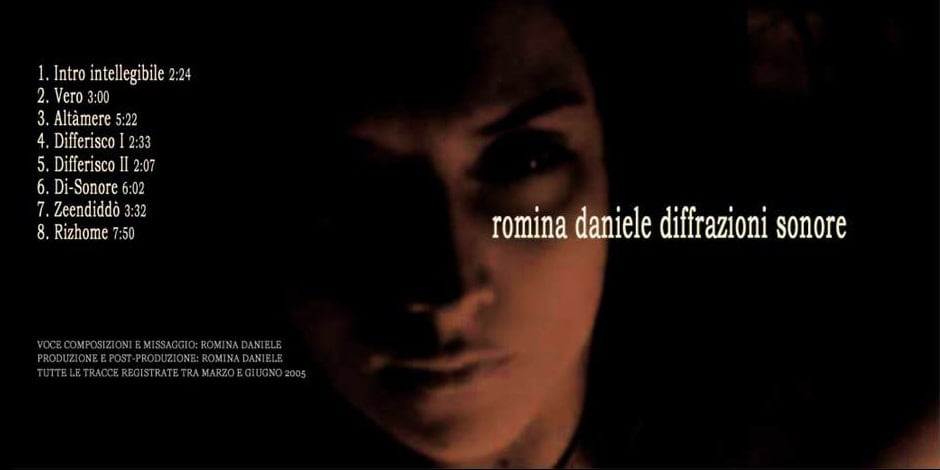

An introduction: The work by Romina can be placed, if a simplification may be granted, within the avant-garde. And a prayer: to maintain an ear free from preconceptions, stripped of any pre-established code regarding music—what is commonly understood by it, its structures, and its constitutive elements. Now we are ready to listen to "Diffrazioni Sonore".
The most evident affinity that surfaces after a few minutes is with the solo works of Demetrio Stratos: like the late singer of Area, Romina has centered her work on the voice. The voice is understood as an instrument (every sound present on the record is the fruit of her vocal cords) potentially more versatile than the limits imposed by customary use; the voice as the carrier of a language (not necessarily intelligible); and finally, the voice as a research probe: how far can one go with the medium of the voice?
The realization of this project, which is moreover supported by a solid philosophy that constitutes its manifesto, so to speak, reflects the desire to break free from common processes: recording long sessions of vocal improvisation, allowing them to develop into hypnotic mantras or complex vocalizations; unleashing gibberish or sounds one would not think reproducible by a human throat (the control and the vast variety of timbres she manages to obtain from her voice reveal the rigorous discipline Romina has undergone).
The subsequent phase, which contrasts with the first by reasserting control and applying deliberate choices, consists of editing and assembling these recordings to construct the tracks. The method is as fascinating as the final result.
Evidentially, works like "Diffrazioni Sonore" are more pregnant with questions than with stable assertions: Where is the line that separates experimentation from accidental results? How many will be able to discern a palette of vocal expressions embedded within a project from a 'freak show' of the phono-articulatory apparatus? To what extent can a research into personal limits be extended (and accessible) outside its intrinsic hermeticism? Yet, regardless of these speculations, it must be said that Romina probably demonstrates more courage today in presenting a work like this than was needed by Stratos in the 1970s, when an audience that still valued experimentation actually existed.
"Diffrazioni Sonore" makes the leap, elevating itself above mere demonstration, thanks to its extreme viscerality. By proposing an alternative path to the music-text union, it represents a spectrum of feelings and moods: restlessness, anguish, rage, neurosis, liberating madness, carefreeness, and lightness. Romina flays the skin off emotions to reach the raw flesh, destabilizing the listener who will hopefully remain spellbound, but inevitably marked by the experience.
Considering the young age of the artist and that her research has, one might say, only just begun, we can expect nothing but highly interesting things for the future...
(LUCA RAPETTI ALIAS SLOVO, BLOGBUSTER.IT)
ROCK IMPRESSIONS
We immediately seize this opportunity to remember (though we have never forgotten him) one of the most important vocalists in the world: Demetrio Stratos. It may seem inadequate to begin a review in this manner, but then again, Romina Daniele is dedicated to vocal experimentation just like the Greek artist from Area. The voice in itself is an instrument, but humanity has rarely pushed past a certain limit—whether out of fear of damaging the vocal cords or due to a lack of necessity, since few are interested in listening to a forced, unmelodic sound. Yet, we reiterate that the voice is an instrument, and as such, it ought to be used. I used the conditional because even we, as consumers of music, often turn up our noses at certain experiments. That is a mistake; one should approach this discourse with the appropriate "cultural" and mental preparation, fully aware that they will encounter neither melodies to hum along to, nor music to whistle.
Romina Daniele is young, but her entire life is dedicated to art: she studies guitar, writes poetry, paints, and studies the history and methodology of art, as well as film theory and history. In 2005, she was awarded the Demetrio Stratos International Prize for Musical Experimentation, and this alone is enough to bring the artist into focus.
In "Diffrazioni Sonore", we listen to half an hour of vocalizations, improvised during a three-hour studio session, yet conceived over three years of solitude, passion, and silence, as the artist herself likes to say. It is a sonic experiment in which the voice transforms into a thousand different textures, just like an elastic band when plucked and stretched.
Personally, I did not believe that in this day and age there were still artists in circulation with the desire to create in the purest sense of the word; today everything revolves around the "almighty dollar," and a product of this kind certainly does not pair well with it. On me, this record had a strange effect: upon the first listening, I thought it was "anachronistic"; upon the second, "futuristic"; in reality, I came to realize that "Diffrazioni Sonore" is nothing other than Romina Daniele and her own "Ego." Within her voice, you will find new colors to enrich your palette, if you so wish; to everyone else, I recommend a preparatory listen.
(MASSIMO SALARI, ROCK-IMPRESSIONS.COM)
THE HOLY HOUR
Does anyone know where the voice is born? Where does it go? What purpose does it serve, and how does it function? Is it possible that this medium of communication, this musical instrument innate to human beings, remains paralyzed within certain mental preconceptions tied to a limited or, worse, incorrect usage?
In the West, this wall was torn down by Demetrio Stratos—the voice, and not merely in a restrictive sense, of the avant-rock group Area. Starting from rock and rhythm & blues—a fundamentally popular sound landscape—Stratos propelled his vocal research beyond every known limit of musical experimentation. He augmented his artistic endeavors with scientific, psychoanalytic, and ethno-anthropological investigations, allowing him to master diplophonic and triplophonic throat-singing techniques originating from Mongolia and Tibet, ultimately shifting toward the sonic avant-garde applied to theatrical expression, as pioneered by Antonin Artaud.
This is admittedly a broad but certainly not unfocused preface to introduce Romina Daniele. She proves to be a worthy successor to Stratos, yet she has not delivered a merely mannerist or derivative piece; on the contrary, her work is intensely personal and thoroughly re-elaborated. Grounded in a remarkably forward-thinking musical background (classical guitar studies, alongside collaborations spanning jazz, blues, and rock), Daniele won the 2005 "Demetrio Stratos" International Prize for Musical Experimentation, where she presented "Diffrazioni Sonore". There is really nothing else to say: it is a masterpiece.
Regardless of her exceptional technical capabilities, Romina plays with her voice, rendering it infinitely flexible in every dimension. Here, the spoken word loses all conventional importance; where it does appear, it serves as a mere pretext to illuminate colors, tones, sonorities, and noises to which our ears are no longer accustomed. The new technologies applied in the recording studio further accentuate those micro-variations that constitute this unique phonic material—a material no less eloquent than spoken language itself.


For any insatiable connoisseur of Stratos and his artistic lineage, listening to the work of this magnificent and unbridled experimenter will be deeply fascinating. Romina Daniele offers us the opportunity to witness the legacy of Stratos re-envisioned through a female perspective. Indeed, by utilizing diamesic variations within language (entering the pure realm of linguistics)—that is, the variations derived from changing the medium used in communicative interaction—and diving deep into the discourse of the "medium-voice," the differing biological sex of the speaker introduces entirely distinct physical mechanics and modes of expression.
When we map this onto vocal experimentation as Romina conceives it, we observe striking shifts compared to Stratos's body of work—not to mention that the phonic structures Stratos utilized were rooted in a different native language, which is no small factor in his research.
These are highly complex concepts, yet they are of primary importance within an experimental framework. Romina gives "voice to the voice"—this is her monumental contribution. She succeeds in making her entire body pass through the "language," just as Demetrio famously pronounced in his time.
In drawing to a close, oceans of ink could be spilled over works of this nature; a mere "review" feels limiting, incapable of fully capturing the vibrations that a masterpiece like "Diffrazioni Sonore" generates within the listener. Romina's magnificent voice is meant to be "felt" (sentita). Here, "feeling" does not merely imply physical or theological/sophic dimensions; rather, it compels the attentive listener to re-train their ear, analyzing the voice down to its primordial nucleus to uncover a fascinating genetic and emotional code.
Ultimately, I do not know if a "layperson" or someone unaccustomed to this level of experimentation will happen upon this great sonic document. However, I urge them neither to be scandalized nor to approach it with a mocking or dismissive attitude; for what Romina achieves is something we are all, potentially, capable of realizing. It is simply a matter of understanding how it works.
(ALESSANDRO NESPOLI, THEHOLYHOUR.ORG)
TERRITORIO MUSICALE
The work carried out by Romina Daniele over these years cannot have been an easy path. The research, upon which her entire output is founded, is exasperated to the bone, only to be recaptured in distinct, improvised sequences, and subsequently embedded—almost by force—onto a rigid medium. Within this medium, you will find neither conventional music, nor songs, nor compositions, but solely the most intimate essence of Romina. Neapolitan and presumably quite strong-willed, Romina has driven this project from the very beginning; it matters little whether she studied, attended the conservatory, or performed a myriad of concerts. The result, the raw material, is entirely in here.
Uneasiness, happiness, pleasure, and serenity are but a few of the sensations that Romina manages to transmit to us through the most versatile and malleable instrument available to everyone: the voice. The entire work rests upon this—the voice taken as the sole fountainhead of any melody that flows from it. Almost unconsciously, Romina brings into being a splendid work within the contemporary landscape, one that in all probability will not receive the recognition it truly deserves.
The entire project develops around an almost theatrical atmosphere, rendered even more pronounced by Romina’s magnificent vocal ups and downs. Raw and intensely visceral, the artist succeeds in enchanting us with splendid spasms that interlock perfectly with one another in an imaginary sonic puzzle. At this point, dividing the work into tracks becomes redundant; the project could, in fact, begin and conclude as a single, monumental opera.
In essence, I believe this is one of the most interesting works to emerge from our country in recent years, and to remain without it would be absolutely unforgivable.
(FRANCESCO OVARELLI, TERRITORIO MUSICALE)
PROG MOVEMENTS
IMPROVISATION, MONTAGE, VOCALITY, AND DIFFRACTIONS
When discussing Area and Demetrio Stratos, the recurring question is always: who has claimed their legacy? Here she is—a formidable heiress, not merely of vocal technique, but above all, of the spirit of exploration and "transversality" inherent to Stratos’s research. In 2005, Romina Daniele was awarded the "Demetrio Stratos International Prize for Musical Experimentation," a massive recognition well-deserved thanks to a project as forward-looking and audacious as "Diffrazioni Sonore".
The work was composed and produced entirely by Daniele herself, who establishes herself as an ideal trait d'unionbridging diverse artistic schools of thought, from Donella Del Monaco [...] passing through to the inevitable Stratos. The voice—with all its nuances, overtones, and capacity for "transfiguration"—is the absolute protagonist of the record, which leaves the impression of being a pulsating and deviant "sonic canvas," particularly in unsettling tracks such as "Altàmere"and "Di-sonore". The opera is born from improvisation ("unbridled," as the author defines it) and takes shape through a process of "montage"—an operation that is almost cinematographic in nature, vastly different from the recent album by Albert Hera, which remains closer to pop and world music solutions.
She is a cultured, courageous artist who richly deserves both attention and support...
(DONATO ZOPPO, MOVIMENTI PROG)
ROCKAMBULA
"Diffrazioni Sonore" by Romina Daniele is something that, despite all my mental efforts, I would never have anticipated: nothing even partially attributable to a single genre, but rather an elegant and seductive vocal experimentation. It is an album that strongly honors the attributes of the gifted Romina, marked by sometimes courageous decisions rewarded with praiseworthy results. The "Opera" in question is challenging; the initial impact is not the most natural, but within a very short time, curiosity stimulates a continuous listening that in the first few minutes seemed improbable.
I find myself listening to "Diffrazioni Sonore" in a completely different state of mind than usual, navigating through conflicting sensations and moods until the total explosion of my head—perfect electronics blended with a unique voice of leaden tones, traversing cold, snow-covered paths through my imagination. Continuous research and innovation form the foundation of this flawless work by Romina Daniele, a Milanese by adoption; finding new paths when everything seems already done is undoubtedly a synonym for talent. Without too many unnecessary words, "Diffrazioni Sonore" richly deserves sincere applause.
(RICCARDO MEROLLI, ROCKAMBULA.COM)
SANDS-ZINE
(...) But if instead you are looking for something completely disconnected from the interpretation of scores written by third parties, then "Diffrazioni Sonore" by Romina Daniele might be the record for you. It is all too easy, while listening to it, to bring up names such [...] Demetrio Stratos (who knows, perhaps Daniele has a pinch of Greek blood in her veins too?!), and a confirmation arrives upon noting that the singer won the 2005 "Demetrio Stratos International Prize for Musical Experimentation." Yet, deepening the listen, one seems to perceive numerous other influences, direct or indirect, which would turn out to be far more unpredictable (I do not want to talk nonsense, but at a certain point, there seems to be a citation, whether intentional or not, of Laurie Anderson).
Daniele's working method consists of recording totally free vocal improvisations—suspended between singing, reciting, screaming, and vocalisms in the broadest sense—which, in a subsequent phase, are edited and arranged into rather complex clusters of voices that possess the characteristics of authentic compositions. This is clearly a contemporary concept of the composition process, in which the writing does not occur on paper but on tape or hard disk, and which nonetheless involves a process of arrangement, correction, and revision equal to classical musical notation.
Romina Daniele can be placed within a new group of experimenters exploring the expressive possibilities of the voice, which finds a more naïve representative in Madame P and a male counterpart in Enomísossab. "Diffrazioni Sonore" is certainly an interesting album, even if a touch of immaturity can still be noticed and the payment of a few artistic debts remains a bit too pronounced; nevertheless, the substance and the ideas are absolutely there, making it easy to predict highly interesting developments (at this point, everything depends on Daniele's determination and actual opportunities). I allow myself to add—though here we fall into personal taste—that a relative softening of the atmosphere would play positively on the final result.
(ALBERTO CAROZZI, SANDS-ZINE.COM)
Other releases




Aisthànomai, Il Dramma della Coscienza
Album 2008
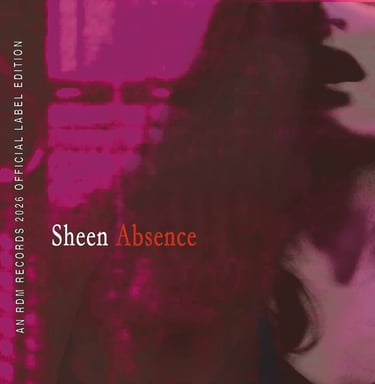
SHEEN: ABSENCE (2026 OFFICIAL LABEL EDITION)

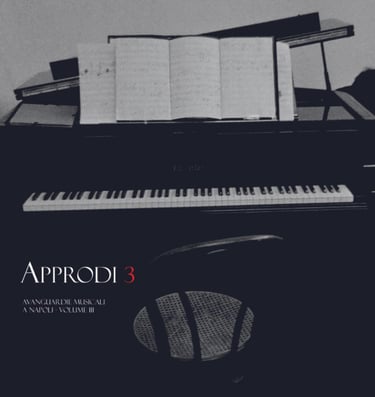
APPRODI III (2021)
AA.VV. Compilation
SPANNUNG
Album 2015
Get in touch


© 2005–2026 ROMINA DANIELE. ALL RIGHTS RESERVED.
ALL ARTISTIC WORKS, THEORETICAL ESSAYS, AND AUDIO-VISUAL MATERIALS ARE THE EXCLUSIVE INTELLECTUAL PROPERTY OF THE AUTHOR. PLUGINS AND CONTACT FORMS COLLECT MINIMAL DATA FOR SECURE, DIRECT CORRESPONDENCE ONLY. AS AN INDEPENDENT INSTITUTIONAL PLATFORM DEDICATED TO PURE PHENOMENOLOGICAL, VOCAL, AND SONIC RESEARCH, THIS ARTISTIC ENTITY MAINTAINS A STRICT POLICY OF COMPLETE DETACHMENT FROM ALL FORMS OF BLASPHEMY, EXPLICIT THEMES, OR PROFANE PERFORMANCES, SYSTEMATICALLY EXCLUDING THEM FROM ITS CATALOG AND SCOPE.