



ElectroAcoustics Magazine - Living Voice: workshop with Trevor Wishart (2011/07/30)
Part of the inaugural Milanese editions of ElectroAcoustics Magazine (RDM Records, 2011–2012), this text anchors the historic Italian roots of the magazine, which has expanded internationally with the launch of our new US hub, continuing to publish cutting-edge critical literature and research around sound and technology today.
[ElectroAcoustics Magazine July 30th 2011] The Belgian Institute for Living Voice, produced by Muziektheater Transparent under the artistic direction of David Moss, will hold its fifteenth educational and performative event dedicated to contemporary vocality in Brazil from December 13th to 18th. (1) We take this opportunity to recall the fourteenth appointment, held between October 7th and 11th, 2010, at the Cini Foundation on the spectacular island of San Giorgio in Venice, which consisted of intensive workshops, debates, conferences, and concerts by Trevor Wishart, Barbara Hannigan, and David Moss himself. (2)
The workshop we are reporting on is the one held by the English composer and free performer—specifically a performer of extended vocality improvisations—Trevor Wishart. The history of (electroacoustic) music and the relationship between human vocality and technology owe much to Wishart, who was invited as a guest professor by the Institute evidently for the latter of his expertise. However, the cycle of meetings proved to be of extreme interest, especially from a compositional perspective, as Wishart's vocal improvisation performances—as seen in the final evening concert—can be viewed as pure samples of his conception of liberated vocality (which is nonetheless demanded of the performers or set to score). These are emblematic examples of the vocal types necessary for the rendering of his electroacoustic compositions. Indeed, the composer typically records his own improvising voice to then compose electroacoustically; particularly emblematic in this sense are the compositions Vox V and Red Bird. (3-4)
The cycle of meetings lasted a total of 12 hours distributed over three days, with about twenty participants of various ages, including voice students, singers, actors, composers, artists, and musicians in general.
During the first day, Wishart presented some of the extended techniques he utilizes, stimulating the participants—arranged in a circle in one of the large conference rooms or in groups scattered throughout the environments of the Cini Foundation—to experiment with sonic-vocal variations starting from an idea, a rhythmic base, and/or a text. The other two days were dedicated to Wishart's "rich experience in the notation of new vocal sounds" (5), particularly to the performative rendering of two of the composer's electroacoustic masterpieces for electronics and amplified voices: Vox IV and Anticredos.(3-4)
In line with his compositional activity, based on the computer-aided transformation of the human voice performing extended vocal techniques, the voice in Wishart's work is investigated primarily in its noise-like nuances to achieve the production of every possible and imagined sound, as well as the reproduction of natural or mechanical sounds. The workshop participants, divided into groups, were encouraged by the composer—driven by his strong engagement and humor—to create a true "group voice," giving form to syntactically organized vocal flows, specifically to imitate a swarm of bees or the sound of a bell. These are two interpolation phenomena well known to scholars (6) and attentive composers, utilized by Wishart in the compositions Vox V and Red Bird. (3-4)
On one hand, every individual, even in an imitative attempt, always produces a different sound, which is the peculiar characteristic of the voice; on the other hand, there is both the sense of vocality that imitates and merges with nature, and that of the social group expressing itself heterogeneously yet chorally—a very strong aspect in Wishart's entire production. The proposed undertaking, as arduous as it is impossible, also underlines another methodological constant of Wishart's composition: like his charts and scores, his performative indications and descriptions are charged with metaphors calling attention to the sounds of the external world, natural or mechanical, so that the voice can reproduce them to their maximum limits, at the point where only the computer can intervene.
In Wishart's production, as in the movements of the Vox Cycle (1990, Virgin Classics) [3], voices relate to electroacoustic elements of various types—concrete and processed sounds, pre-recordings, spatialization—while the score defines in more or less detail how the voice must move. In exposing his vocal approach to a group of vocalists, and in contrast to his completely free improvisational conception, the composer confronts them with his scores and provides specific vocal examples with his own voice.
The rendering of these compositions by the workshop participants was challenging due to the extreme complexity of the scores (7), composed in macro-levels with internal articulations for each voice and specific reference nomenclatures, all based on a completely new notation created and used solely by Wishart. In the case of Vox 4 for eight voices, "invented textual material" is added, which the composer explains he obtained by improvising, recording, and cataloging fragments via computer, resulting in a series of possibilities selected for their sonic qualities to be submitted to the performers.
The complexity performers must face is evident, and Wishart himself addresses the problem of the validity of the notational operation. He seems to require of the voices the same precision in control and management of sonic variety that he adopts in composition regarding the transformation of sound over time. While free improvisation allows for direct vocal expressions unmediated by known musical conventions or linguistic systems, the composition developed from these materials requires extremely detailed notation for the performers to execute them.
The workshop days were complemented by debates, performances by the participants, and the final concert by Moss and Wishart. This concluded with the presentation of Globalalia (composed in 2004 and published by Flying Swimming in 2010), a composition that reaches the representative peaks of what the author defines as "discursive gesture"—a direct reference to the sounds of language emancipated from any signification. The title is a neologism combining "global" and "glossolalia," presenting the universal dance of human language as revealed in stories from everywhere. The 29-minute piece is based on the use of syllables, a selection of 8,300 recorded sounds from almost all the languages of the world, structurally combined via computer to extract their intrinsic musicality.. (9) [L. Marranini/R. Daniele]
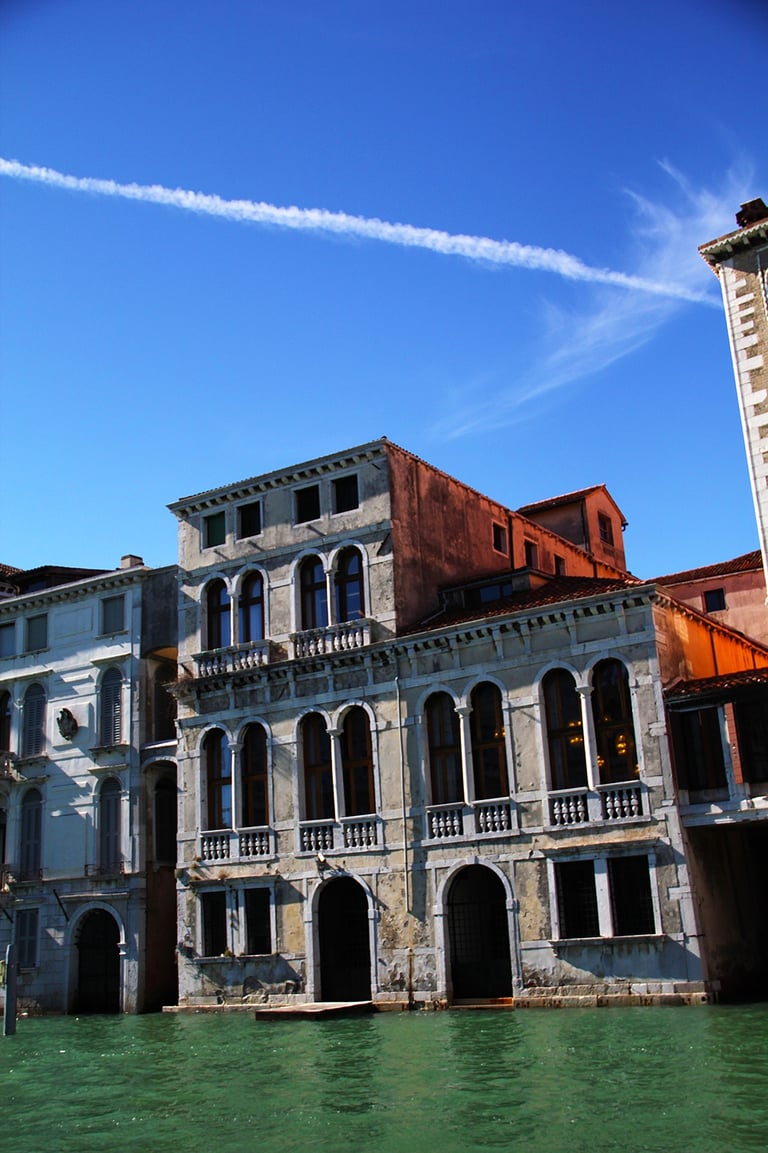
Between 7-11th of October 2010 we were attending at the Cini Foundation, on the spectacular island of San Giorgio in Venice, the intensive workshops, debates, conferences and concerts, by Trevor Wishart, Barbara Hannigan and David Moss, promoted by the Living Voice.
Trevor Wishart is a worldwide acclaimed English composer and free performer or performer for extended vocal improvisations, whose work, in the field of (electroacoustics) music and in the relationship between human vocality and technologies, is hugely important. And he was called as a guest professor by the Living Voice Institute evidently for the second of his skills.
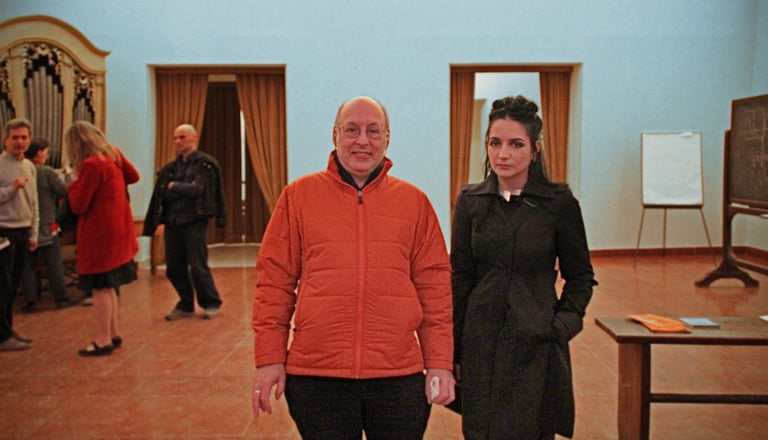
In the pictures: Trevor Wishart and Romina Daniele. A detail from Venice by Romina Daniele Photography.
Footnotes
1. Institute for Living Voice: Official event documentation and archives (Venice, 2010).
2. T. Wishart: Vox Cycle Score, University of York Press.
3. Vox Cycle and Trevor Wishart : official website.
4. Red Bird/Anticredos, cd, UK, October Music, 1992
5. Venice event.
6. T. Williams, Vox 5 by Trevor Wishart. The analysis of an electroacoustic tape piece. "Journal of Electroacoustic Music", vol. 7, 1993.
7. T. Wishart Vox Cycle Score. University of York Press, 1986.
8. T. Wishart, Globalalia, note di copertina del cd.
9. T. Wishart, Intervista condotta dalla London Sinfonietta in data 2009.01.01.
Get in touch


© 2005–2026 ROMINA DANIELE. ALL RIGHTS RESERVED.
ALL ARTISTIC WORKS, THEORETICAL ESSAYS, AND AUDIO-VISUAL MATERIALS ARE THE EXCLUSIVE INTELLECTUAL PROPERTY OF THE AUTHOR. PLUGINS AND CONTACT FORMS COLLECT MINIMAL DATA FOR SECURE, DIRECT CORRESPONDENCE ONLY. AS AN INDEPENDENT INSTITUTIONAL PLATFORM DEDICATED TO PURE PHENOMENOLOGICAL, VOCAL, AND SONIC RESEARCH, THIS ARTISTIC ENTITY MAINTAINS A STRICT POLICY OF COMPLETE DETACHMENT FROM ALL FORMS OF BLASPHEMY, EXPLICIT THEMES, OR PROFANE PERFORMANCES, SYSTEMATICALLY EXCLUDING THEM FROM ITS CATALOG AND SCOPE.