



«The dialogue with the disintegrated and recomposed matter»
an analysis of Thema (Homage to Joyce) by Luciano Berio.
Editorial Note: The following text, available in Italian only in its full edition, is an abstract from Romina Daniele’s monograph, written during her years at the Conservatorio di Milano (2009–2010) and published in full by RDM Records in 2010.
[...] Thema (Omaggio a Joyce) from 1958, an electroacoustic piece by Luciano Berio for voice and magnetic tape, is a work that thrives on the interactions between different linguistic structures and modes of artistic making, and is based on the composer's study — in collaboration with Umberto Eco during an initial phase of the work — of such interactions: the poetry and literature of James Joyce; the interpretive reading and voice of Cathy Berberian; linguistics as the presence of multiple languages, hence vocality under diverse aspects (linguistic-phonetic, anthropological, musical). The final phase of this study is constituted by the piece for magnetic tape, realized with sounds drawn from Cathy Berberian's voice reading the opening lines of Sirens, Chapter XI of James Joyce's Ulysses.
[...] It is necessary to situate oneself «within the specific horizon of a philosophy of art capable of composing into a 'great unity' the spiritual world and the physical one», in which things are observed «through a sort of essential intuition that allows one to grasp the correspondences, analogies, and differences that bind things together» [2].
[...] Thema is constructed starting from this primary oscillation and tension between «oblivion» and «construction» that characterizes poetic writing par excellence.
[...] Montage is the compositional operation involving the processing of previously recorded and selected sounds and inaugurating the aesthetics of the «text torn to pieces» [3]: Berio’s Thema constructs a «discourse that speaks of the limits of modern rationality» beyond the boundaries between the arts, staging «a language capable of 'saying' the force, the genesis, the obscure that lies at the root of form» in a traversal that moves from literature to music and multimedia language [4].
[...] Thema (Omaggio a Joyce) constitutes the central work of this type of activity, since «in it, the interdisciplinary vocation of the Milan studio and Berio’s interests in linguistics and phonetics find musical realization» [5].
[...] When Berio speaks of a «synthesis between different and often contrasting experiences» [6] (...) he refers, in relation to the «indispensable artisan condition» [7], to «a new human perspective of research» (...) employing «for musical purposes the means that electroacoustic and electronic technology make available» and tending toward research «beyond the confines of artistic and scientific specializations» [8].
[...] The relationship (or gap) between the «musicality of language» [9] and music proper constitutes the initial motive of interest for Berio and Eco (...) concerning, on the one hand, music, and on the other, Joyce's writing (...) the «definitive writer», «the poet of a new human form of consciousness» [10]. The procedures of electroacoustic processing and montage address simultaneously word and sound, reunited in the voice, representation of the «originary tension toward becoming language» [11], the vehicle through which «sound becomes meaning» [12].
[...] Berio's operation, compositional par excellence, makes of Joyce's text «what remains of Joyce's text» [13] (...) through montage, it enacts the «act of construction» mentioned from the very first page; whereby the matter, originally «disintegrated», can definitively be called «recomposed».
[...] Regarding vocal production and the physicality of sound matter, finally, «resonance» refers directly to the body as a resonator through which the human voice conveys the production of sounds and noises. On the one hand, Berio classified and grouped «into chords almost all the words present in the text according to a scale of vocal colors» whose arrangement corresponds to the «resonance points of the vocal apparatus» [14]. On the other hand, emphasis is placed on the voice as a symbol of bodily presence and expressive sign thereof, rather than a mere means of verbal communication, a system of distinctive and signifying articulated sounds [15].
[...] In this sense, the poetic voice is a «symbol of language»; therefore, in the disintegration of the speaking vocal sound lies the interdiction of the pure linguistic principle and the establishment of the dimension «of things».
[...] The idea of poetry to which Berio refers is that of «total poetry», whose meaning «is located in the abstruse, hidden, closed plot that lies at the bottom of all things» [16] and whereby the poetic-musical work does not resort to themes so much as to the very forms of language [17] (...) In this sense, Thema «does not wish to signify anything other than its own structure» [18], that is, the constructing of itself independently of theoretical organizational principles.
[...] Thema is based on the «principle of segmenting the object into different camera angles/takes» [19] — the segmentation of the Joycean text into voice — and of reunifying it into a complete sonic image — the reconstruction that Berio makes of it. This is the peculiarity of montage, which establishes parallelisms between electroacoustic music and cinema, and which «leaves the advent [avvenimento] intact — Joyce's poetry — and at the same time interprets it differently» [20] — in the form of Berio's work.
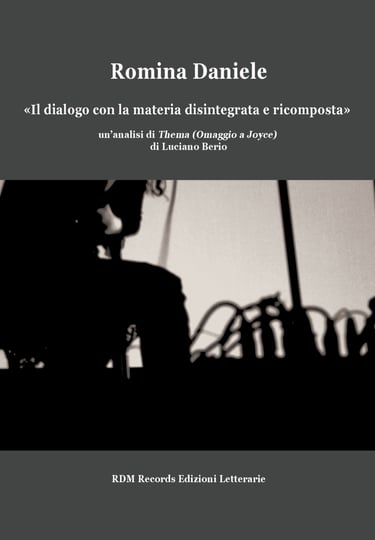
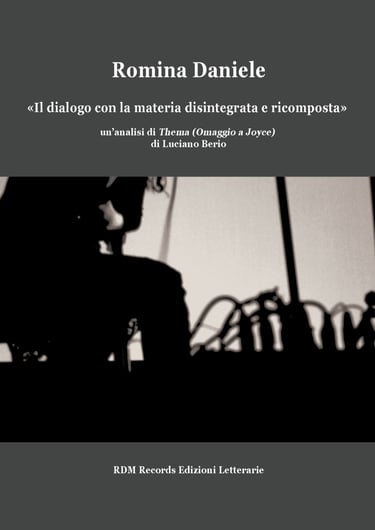
The «dialogue with the disintegrated and recomposed matter» [1] is the site in which the author reaffirms, refracting them from the standpoint of music, certain fundamental concepts on artistic making inextricably connected to technologies as well as to the conditions of knowledge; from the very first pages, the concepts of material and possible world-orders are presented, followed by the theories of integration between different structures and the need for intellectual commitment toward the disparity of operating terms, and of the intimate connection between electronic music in the studio and cinematographic work — citing and arguing once again the great thinkers of reference: Michel Chion and Gilles Deleuze, Jacques Derrida and Roland Barthes, Sergei Ejzenštejn, Henri Bergson, and Martin Heidegger. The essay represents a concise compendium of the main Italian analytical contributions on the examined piece, Thema (Omaggio a Joyce) by Luciano Berio, the first major electroacoustic work in history for voice and magnetic tape to be based on the montage and processing of recorded vocal materials, starting from a fragment of James Joyce’s Ulysses.
Footnotes
[1] Radio broadcast Omaggio a Joyce. Documenti sulla qualità onomatopeica del linguaggio poetico (1958), edited by Luciano Berio and Umberto Eco, CD, published with the volume AA.VV., Nuova Musica alla radio. Esperienze allo Studio di fonologia della RAI di Milano, 1954–1959, edited by V. Rizzardi and A. I. De Benedictis, CIDIM-RAI, 2000, track 48.
[2] A. Trione, L'ordine necessario, Recco (Ge): Il Nuovo Melangolo, 2001, pp. 28–30.
[3] M. Chion, L'Art des sons fixés ou La Musique Concrètement, Fontaine: Éditions Métamkine / Nota-Bene / Sono-Concept, 1991 [It. tr. L'arte dei suoni fissati o La Musica Concretamente, Roma: Edizioni Interculturali, 2004, p. 98; no published English translation, title translated as The Art of Fixed Sounds, or Music Concretely]. The reference is to «that compositional category of contemporary art in which the word is used as a primary source, playing with the tension between the semantic characteristics and the abstract musical ones of language, principally through technology» [C. Lane, "Voices from the Past: compositional approaches to using recorded speech", in Organised Sound, 11(1), 3–11, United Kingdom: Cambridge University Press, 2006, pp. 1–2. Author's translation].
[4] G. Vattimo, Derrida e l'oltrepassamento della metafisica, introduction to the Italian edition of Jacques Derrida's L'écriture et la différence, Paris: Éditions du Seuil, 1967 [It. tr. La scrittura e la differenza, Torino: Einaudi, 2002, pp. XIII–XV; Eng. tr. Writing and Difference, trans. by A. Bass, Chicago: University of Chicago Press, 1978].
[5] N. Scaldaferri, Musica nel laboratorio elettroacustico. Lo Studio di Fonologia di Milano e la ricerca musicale negli anni Cinquanta, Lucca: Libreria Musicale Italiana, p. 81.
[6] L. Berio, «Prospettive nella musica», in Elettronica e telecomunicazioni, Year XLVII, no. 2/3, December 1998, Rai-Eri, p. 59.
[7] Ibidem.
[8] Ivi, p. 66. Author's italics.
[9] N. Scaldaferri, «Bronze by Gold by Berio by Eco, Viaggio attraverso il canto delle Sirene», in Nuova Musica alla radio. Esperienze allo Studio di fonologia della RAI di Milano, 1954–1959, cit., p. 111.
[10] U. Eco, Le poetiche di Joyce, Milano: Bompiani, 1966, p. 348 [Eng. tr. The Aesthetics of Chaosmos: The Middle Ages of James Joyce, trans. by E. Esrock, Cambridge, MA: Harvard University Press, 1989]; cited in N. Scaldaferri, «Bronze by Gold by Berio by Eco, Viaggio attraverso il canto delle Sirene», cit., p. 148.
[11] A. Di Scipio, «Da un'esperienza in ascolto tra phoné e logos. Testo, suono e musica in Thema (Omaggio a Joyce) di Berio», in Il Saggiatore musicale, Year VII, Bologna, 2000, p. 327; cf. J. Derrida, La voix et le phénomène. Introduction au problème du signe dans la phénoménologie de Husserl, Paris: PUF, 1967 [It. tr. La voce e il fenomeno, Milano: Jaca Book, 1968; Eng. tr. Speech and Phenomena, trans. by D. B. Allison, Evanston: Northwestern University Press, 1973].
[12] «Vocal music, Berio once declared, is a 'staging' of the word. And on another occasion he stated that it interests him insofar as it mimes and describes 'that prodigious phenomenon which is the central aspect of language: sound that becomes meaning’». [E. Sanguineti, «La messa in scena della parola», in AA.VV., Berio, Torino: E.D.T., 1995, p. 74].
[13] In this regard, in the documentary Omaggio a Joyce one hears: «Through the multiple possibilities of organizing vocal material, we are therefore at the threshold of a new world rich in promise, a world that is no longer that of Joyce's text, yet one in which Joyce ultimately enacts the legacy of experimentation to the utmost» [Radio broadcast Omaggio a Joyce. Documenti sulla qualità onomatopeica del linguaggio poetico, CD, cit., track 45].
[14] L. Berio, «Poesia e musica – un'esperienza», in AA.VV. (ed. by Henri Pousseur), La Musica Elettronica, Milano: Feltrinelli, 1976, p. 131. The text is also in AA.VV., Nuova Musica alla radio. Esperienze allo Studio di fonologia della RAI di Milano, 1954–1959, cit., pp. 237–259; and previously published in Incontri Musicali. Quaderni internazionali di musica contemporanea, Year 3, Milano: Suvini Zerboni, 1959, pp. 98–111.
[15] Cf. W. Benjamin, Über die Sprache überhaupt und über die Sprache des Menschen, in Gesammelte Schriften, Vol. II-1, Frankfurt a.M.: Suhrkamp, 1991, pp. 140–157 [It. tr. Sulla lingua in generale e sulla lingua dell'uomo, in Id., Angelus Novus. Saggi e Frammenti, Torino: Einaudi, 2006, pp. 53–70; Eng. tr. On Language as Such and on the Language of Man, in Selected Writings, Vol. 1, Cambridge, MA: Harvard University Press, 1996].
[16] A. Trione, L'ordine necessario, cit., p. 111.
[17] «Even if it cannot dispose of the same means used by music, poetry is a movement that places itself beyond historical time (...) Mallarmé, engaging in a work of endless precision, continually seeking new devices and inventing new ingenuities, conceived and attempted the most original poetic literary experience of modernity, dreaming of a poetry that was comme déduit from the ensemble of properties and characters of language» [Cf. Ivi, pp. 120–121].
[18] L. Berio, «Poesia e musica – un'esperienza», cit., p. 130.
[19] S. M. Eisenstein, Izbrannye proizvedenija v šesti tomach, Vol. II, Moskva: Iskusstvo [It. tr. Teoria generale del montaggio, Venezia: Marsilio, 1985, p. 354; Eng. tr. Towards a Theory of Montage, ed. by M. Glenny and R. Taylor, London: BFI, 1991].
[20] Cf. Ibidem.
Get in touch




© 2005–2026 ROMINA DANIELE. ALL RIGHTS RESERVED.
ALL ARTISTIC WORKS, THEORETICAL ESSAYS, AND AUDIO-VISUAL MATERIALS ARE THE EXCLUSIVE INTELLECTUAL PROPERTY OF THE AUTHOR. PLUGINS AND CONTACT FORMS COLLECT MINIMAL DATA FOR SECURE, DIRECT CORRESPONDENCE ONLY. AS AN INDEPENDENT INSTITUTIONAL PLATFORM DEDICATED TO PURE PHENOMENOLOGICAL, VOCAL, AND SONIC RESEARCH, THIS ARTISTIC ENTITY MAINTAINS A STRICT POLICY OF COMPLETE DETACHMENT FROM ALL FORMS OF BLASPHEMY, EXPLICIT THEMES, OR PROFANE PERFORMANCES, SYSTEMATICALLY EXCLUDING THEM FROM ITS CATALOG AND SCOPE.